By Charles West July 27, 2025
Running a bakery involves more than just making beautiful pastries, even in the world of perfectly frosted cupcakes and flour-dusted aprons. Every butter croissant has a ledger, and as labor, ingredient, and transaction costs continue to rise, bakery owners are being compelled to consider all aspects of their pricing strategy.
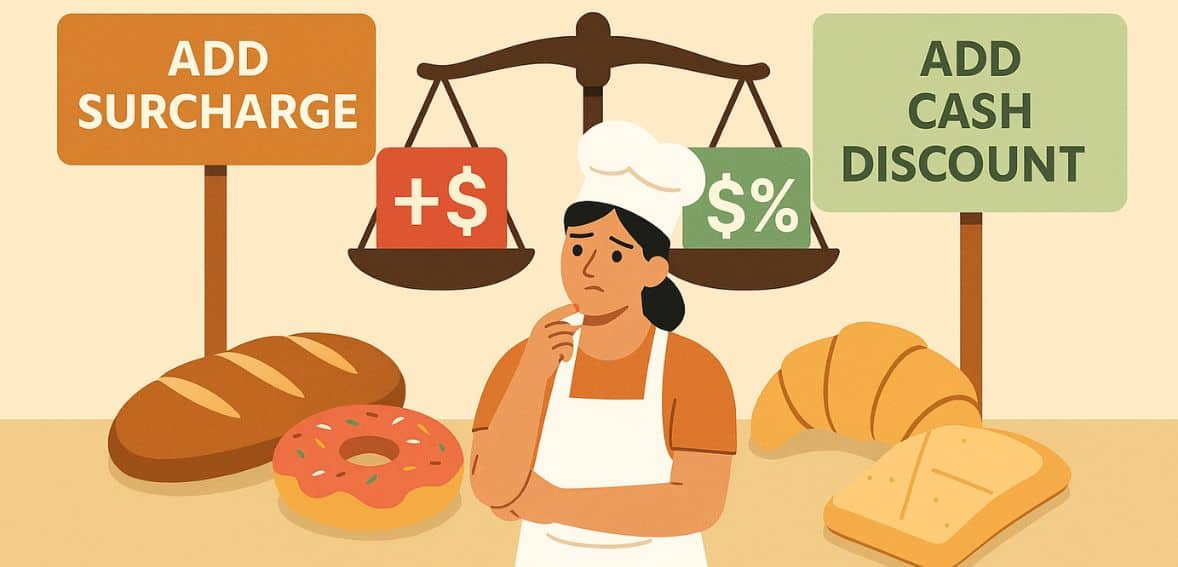
Whether to offer a cash discount or impose a surcharge on card payments is one topic that has generated discussion. Every choice has advantages and disadvantages, and they all directly affect how your customers perceive your business and come back to your counter.
The Economics Behind Every Slice

Running a bakery requires a lot of work and careful consideration of the ingredients. Increasing payment processing fees can subtly reduce your profit margins, which are frequently extremely thin. Those pennies quickly mount up over hundreds of minor transactions each day when each credit card swipe costs you two to three percent of the sale.
These aren’t just numbers in your accounting program; they’re actual dollars that could have been used for new espresso machines, better butter, or employee salaries. You may wonder if there’s a sustainable way to offset the cost as card usage continues to increase, especially when it comes to payment processing for small bakeries, particularly for small-ticket items.
Understanding Surcharges: Passing on the Cost
When a customer decides to pay with a credit card, a surcharge is a percentage fee that is added to their bill. Instead of keeping the transaction fee for yourself, the goal is to pass it on directly to the customer. As long as you adhere to the correct rules and disclosures, it is lawful in the majority of states.
However, legality does not equate to loyalty. A surcharge may seem like a penalty if it is not explained clearly. And in the warm, community-driven environment of a neighborhood bakery, that “extra charge” may come across as impersonal or nickel-and-diming.
Cash Discounts: Incentivizing the Simpler Route

Some bakeries offer a reduced price for cash payments through a cash discount program rather than charging a fee. Since this strategy is a reward rather than a punishment, it is seen as more constructive. Consumers who pay with cash save a little money, and the company saves money on processing fees.
Signage promoting “5% off for cash” tends to perform better than “3% fee for card use,” and the psychology of this model feels less confrontational. However, there is an operational side as well: as more physical money exchanges hands, there is an increase in cash counting, bank deposits, and security risk management.
Regulatory Realities and Compliance
Whichever route you choose—surcharge or cash discount—compliance with payment network rules and state laws is non-negotiable. Card brands like Visa and Mastercard have specific rules about how surcharges are displayed, capped, and communicated.
Similarly, a true cash discount program must be structured so that the posted price reflects the credit card cost , the cash price is discounted from that. You can’t simply mark up card prices arbitrarily. Non-compliance can lead to fines or, worse, termination of your merchant account.
Customer Reaction in a Neighborhood Business
Surcharges may be overlooked in a chain of high-volume stores. The effect is more intimate in your bakery, though, where you are familiar with names, birthdays, and favorite Danishes. A poorly executed pricing change can feel like a breach of trust.
Some customers may shrug it off, while others may see it as a decline in service or value. It’s critical to not only implement these changes thoughtfully but to train your team to communicate them empathetically.
Marketing and Messaging Matter
Depending on how you present this price change, you may lose a customer or gain their understanding. Transparency is crucial when implementing a surcharge. Signage should be respectful and clear. It seems more considerate to use language like “To continue offering the same quality ingredients and service, a small card fee is applied to credit transactions” rather than merely stating the percentage fee. In a similar vein, highlighting the savings in a cash discount makes your customers feel in control and even valued.
Technology’s Role in Surcharge and Cash Discounting
Modern point-of-sale (POS) systems make it easier to manage dual pricing models or add surcharges without manual entry. Make sure your POS can reflect the pricing changes, print compliant receipts, and maintain logs for transparency. Some software even offers automated compliance tools, ensuring your business stays on the right side of card brand rules.
When Is the Right Time to Introduce a Change
If your bakery is feeling the squeeze from rising costs, you’re not alone. But timing and readiness are essential. Look at your monthly card processing expenses. Compare them against how much you’d save if even 30% of customers paid in cash. Then assess whether your customer base is likely to adapt well. Weekends with higher foot traffic might be a good trial period. Test the messaging and the experience before making it a permanent fixture.
Staff Training and Customer Engagement: The Human Side of Pricing Changes
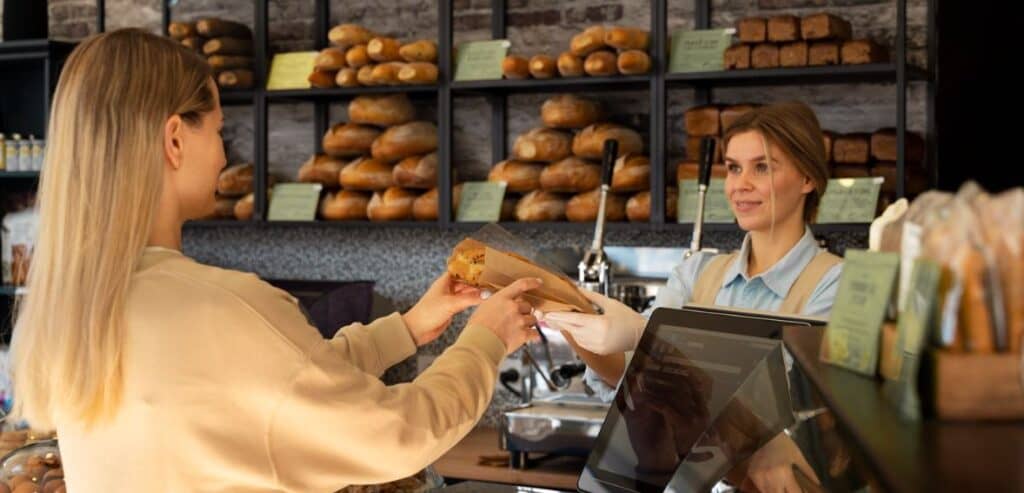
Your team becomes your first line of communication when you implement cash discounts or surcharges. Employees should be able to confidently explain the new pricing model to customers in addition to understanding it themselves. In a bakery setting, where relationships are personal and frequent, the tone and clarity of these conversations matter. Avoid passive confusion at the counter.
Rather, use simple, empathetic scripts that embody your brand voice to train your employees. A narrative that most customers can accept is created, for instance, by stating that the fee supports fair wages or preserves the quality of the ingredients. Role-playing, printed cheat sheets, and brief team meetings can all be very beneficial. An awkward transaction can be turned into a chance to foster brand loyalty and trust by a well-prepared team.
Evaluating Customer Behavior and Purchase Patterns
Following the implementation of a cash discount or surcharge, monitoring consumer behavior becomes crucial. Look past the register; listen to informal feedback, observe conversations, and record regulars’ responses. Are there fewer card users? Are more people choosing to pay with cash? Have you noticed any shifts in the typical tip amounts or ticket sizes? The value of this data is equal to that of your POS reports.
Subtle patterns like people asking more questions or dividing payments differently may also catch your attention. If there is any confusion, take the initiative to change the scripting or signage. Think about putting up a brief suggestion box or conducting a one-question survey. Refinements can be guided by even a few well-considered responses. The secret is to consider price adjustments as flexible rather than set in stone. Remain flexible in response to how your particular customer base reacts.
Understanding Long-Term Cost Recovery and Sustainability

Reducing card processing costs should be the quantifiable financial objective of implementing surcharges or cash discounts. Saving money isn’t the only factor in long-term value, though. It concerns whether the change promotes the overall sustainability of your bakery—can it be sustained, expanded, and understood without depleting employee resources or perplexing customers? If you save $300/month in fees but spend hours each week explaining the policy, you may lose that gain.
Track processing patterns over a few months and reassess whether the model still makes sense. Your strategy should change as your customers’ habits do. Some bakeries trade complexity for simplicity by switching from dual pricing to modest price increases. In the end, the ideal pricing strategy maintains customer clarity, team productivity, and product quality without compromising the experience that makes your bakery unique.
The Emotional Economics of a Small Bakery
Bakeries are emotional places where customers seek solace, celebration, and tradition in addition to providing food. Price adjustments can therefore feel intimate. A surcharge could inadvertently ruin the warm, inviting atmosphere you’ve created. Think about the potential emotional response of your regulars rather than just legality or policy. Present the charge as a means of preserving quality rather than as a fine.
Language is important. You could say, “Cash payments help us reduce overhead so we can keep using premium ingredients,” as opposed to, “Card users pay extra.” Surcharges can feel like a punishment, but cash discounts are more like a reward. Psychology has a significant impact in small community settings. Trust and loyalty can be preserved by keeping your bakery welcoming even when things get tough financially.
Conclusion: Scaling with Confidence
Whichever pricing model you choose—surcharge, discount, or standard—it must grow with your company. Your pricing structure must work well if you intend to grow, start online ordering, or introduce subscription-style sales like birthday cake clubs or catering boxes. Certain surcharges are difficult to integrate into e-commerce platforms, and others may confuse for customers if they are not explained in detail at the point of sale.
Join forces with a payment processor that is familiar with bakery operations and can assist in ensuring platform compliance. Maintain records of your approach, including POS setups, staff training procedures, and language used with customers. This enables you to duplicate successful strategies without having to start from scratch. You can create a bakery that succeeds not just now but also in the years to come by using a pricing strategy that encourages both in-store and future digital expansion.